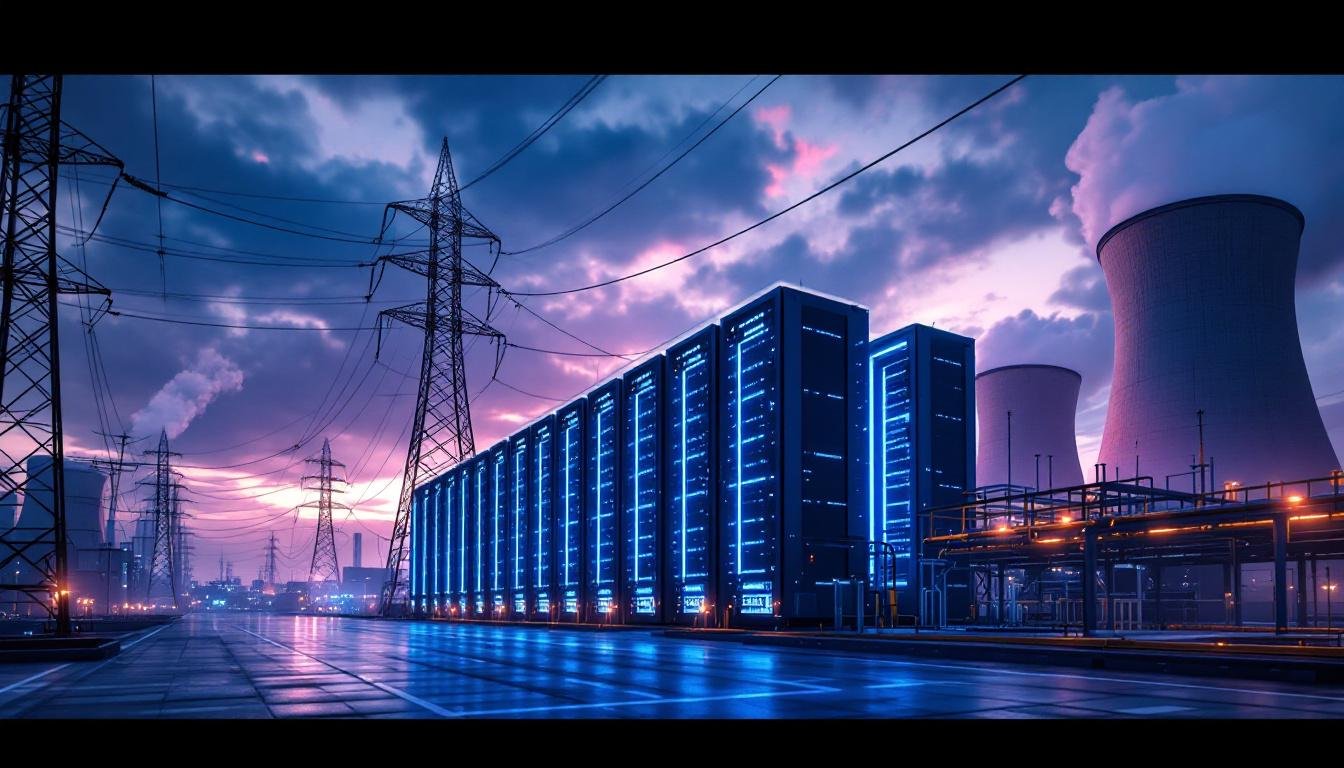
As of early 2026, tech giants are spending billions on private natural gas power plants, and the scale is hard to grasp. AI data centers natural gas projects now span 56 GW across 46 U.S. sites, equivalent to 27 Hoover Dams worth of generating capacity. Microsoft, Meta, Google, and OpenAI are all building off-grid generation infrastructure because the public grid simply can’t keep pace with AI’s power demands. And they’re doing it fast.
Why AI Data Centers Natural Gas Projects Are Exploding
Traditional power grids can’t keep up with AI’s appetite for electricity. Years of flat demand left few projects in development, with new gas plant costs tripling recently and deliveries capped under 20 GW through 2027.
The solution, for companies with the capital to execute it, is to go off-grid entirely.
Companies like Microsoft, Google, and Meta are building “behind-the-meter” setups: modular turbines, engines, and fuel cells that power facilities directly without grid connections. It’s faster, more reliable, and bypasses utility red tape.
The Scale Is Mind-Boggling
According to Cleanview analysis, these 46 U.S. data centers represent more generating capacity than most countries possess. Bloom Energy’s CEO noted their fuel cell backlog (across all segments) doubled in the past year alone as companies scrambled for power solutions.
But here’s what makes this trend particularly striking: it’s concentrated in gas-rich southern states where regulations are friendlier and land is cheaper. Texas leads with 58 GW of planned gas power, more than the next four states combined.
Major AI Data Centers Natural Gas Projects Reshaping Energy
Let’s break down the biggest players and their specific investments:
Microsoft’s West Texas Megaproject
Microsoft partnered with Chevron and Engine No. 1 for a West Texas facility expandable to 5 GW. That’s enough to power roughly 3.75 million homes at peak demand.
Google’s North Texas Expansion
Google commissioned Crusoe Energy to build a 933 MW plant in North Texas. The facility uses aeroderivative turbines for quick startup times, crucial for managing AI workload spikes.
Meta’s Louisiana Empire
Meta’s building seven new plants adding 5.2 GW to its 7.46 GW Hyperion data center in Richland Parish, Louisiana. The company also operates 813 modular generators at its El Paso, Texas site. Meta’s VP Rachel Peterson cited Louisiana’s business-friendly regulations, though company spokespeople dodged questions about reconciling this with climate commitments.
OpenAI’s Stargate Ambitions
The $500 billion Stargate project in West Texas includes dedicated natural gas generation. The Abilene campus alone demands 1.2 GW using advanced aeroderivative turbines for maximum efficiency.
Williams Companies is investing $5 billion for 6+ GW (targeting deployment by 2027) of “behind-the-meter” turbines by 2027 across Texas, Tennessee, and Ohio. Their fast-deploying turbine technology addresses supply chain bottlenecks that have stretched large unit deliveries for years.
How AI Data Centers Natural Gas Consumption Is Reshaping Energy Markets
S&P Global projects AI data centers natural gas consumption will reach 3-6 billion cubic feet of natural gas daily by 2030, up from essentially zero today. To put that in perspective, that’s equivalent to 10 months of total U.S. natural gas supply from a single major producing region.
And current electricity demand patterns show exactly why companies are taking matters into their own hands.
Regional Concentration in AI Data Centers Natural Gas Development
AI data centers natural gas projects are geographically concentrated. Texas dominates the field with projects from Abilene to El Paso. Louisiana follows closely, with Meta’s massive Hyperion complex leading the charge. This geographic concentration isn’t accidental — these states offer abundant natural gas resources, favorable regulations, and lower land costs.
And globally, over 1,000 GW of gas-fired capacity is in development, with the U.S. commanding a quarter of that pipeline. More than a third ties directly to data center demands, according to Global Energy Monitor’s latest analysis.
AI Power Plants: The Technology Fueling AI Data Centers Natural Gas Expansion
These aren’t your grandfather’s power plants. Modern AI power plants use sophisticated technology stacks designed for flexibility and efficiency.
Modular Generation Systems
Companies like Bloom Energy supply fuel cell systems that work like power Lego blocks: stackable, scalable, and deployable in months rather than years. Meta’s El Paso setup exemplifies this approach with hundreds of smaller generators distributed across the facility.
Aeroderivative turbines, derived from jet engine technology, offer quick startup times and high efficiency. They’re particularly valuable for AI workloads that can spike unpredictably.
Behind-the-Meter Economics
Traditional utility-scale projects face years of regulatory approval and interconnection delays. Behind-the-meter systems bypass most of these hurdles by avoiding the public grid entirely.
The trade-off is real: higher per-unit costs but dramatically faster deployment. In practice, companies are willing to pay premiums for certainty and speed in securing power supplies.
A common challenge engineers face in behind-the-meter deployments is fuel supply reliability during peak grid stress events — exactly the scenario where grid-connected backup would normally kick in. Gruppo AB’s Jennbacher units power several Texas data center parks, demonstrating how European engine technology is finding new applications in American AI infrastructure.
Environmental Impact: The Climate Consequences
Here’s where things get complicated. Natural gas burns cleaner than coal, but it’s still a fossil fuel with significant carbon emissions and potent methane leaks.
And methane is 80 times more warming than CO2 over 20 years. Behind-the-meter plants often evade monitoring requirements that apply to grid-connected facilities, creating potential blind spots for leak detection.
Corporate Climate Contradictions
Meta, Microsoft, and Google all have net-zero pledges. Yet their gas plant investments seem to contradict these commitments. Senate Democrats are now probing these companies specifically about their fossil fuel reliance and emissions reporting.
Entergy’s $3.2 billion Louisiana plant pairs 1.5 GW of gas generation with offsetting solar installations. But energy experts question whether these offsets can truly neutralize the gas plants’ emissions.
Based on current emissions reporting gaps, the “shadow grid” concept worries environmental advocates. Companies are essentially building parallel energy infrastructure outside traditional oversight, potentially locking in decades of fossil fuel dependence.
Artificial Intelligence Electricity Demand: Risks and Reality Checks
This rush isn’t without significant risks that could reshape the entire sector.
Supply Chain Bottlenecks
Turbine backlogs stretch years for large units. Two-thirds of U.S. developers currently lack turbine suppliers, according to industry surveys. This constraint forces reliance on smaller, less efficient engines or extended project timelines.
Pipeline capacity presents another critical chokepoint in the supply chain. Moving 6 billion cubic feet daily requires massive pipeline infrastructure that doesn’t exist in many target regions.
Economic Bubble Concerns
Frankly, the speed and scale of investment raises legitimate bubble concerns. AI demand projections might prove overly optimistic, leaving billions in stranded generation assets.
Previous tech booms (dot-com, blockchain mining) saw similar infrastructure buildouts followed by dramatic demand corrections. Could AI follow the same pattern? But the honest answer is that nobody knows — AI infrastructure demand is structurally different from crypto mining in that it’s tied to enterprise productivity rather than speculative value. But the capital commitments are happening faster than the demand forecasts can be verified, which is the classic setup for overbuilding.
Regulatory Backlash Brewing
Off-grid builds circumvent utility oversight, but they can’t avoid all regulation forever. But Senate investigations into emissions reporting and grid stability impacts are just the beginning.
State regulators in Texas and Louisiana are starting to question whether these projects should contribute to grid maintenance costs even if they don’t directly use public infrastructure. It’s a reasonable question that utilities are beginning to document formally. AI data centers natural gas facilities benefit from grid stability (as emergency backup) without contributing to its maintenance — a free-rider dynamic that utilities are beginning to document and challenge formally.
Health and Community Impacts
Concentrated development in southern states raises environmental justice concerns. These facilities produce nitrogen oxides and particulates that affect local air quality.
And construction noise, water usage for cooling, and land disruption compound community impacts. Data on these effects remains limited since most projects are still under construction.
When This Approach Has Limitations
Private natural gas generation isn’t a silver bullet for every situation. The economics, regulatory environment, and corporate sustainability commitments all shape whether this model makes sense — and for a meaningful subset of organizations, it doesn’t.
Private natural gas generation isn’t universally viable. First, companies with smaller power needs may find behind-the-meter solutions economically unviable. The fixed costs only make sense at massive scale. Second, regions with abundant renewable resources and stable grids might not justify the premium costs and environmental trade-offs of private gas plants. Third, companies with genuine net-zero commitments may find the emissions impossible to offset credibly, especially as carbon accounting standards tighten. The approach also struggles in areas with strict air quality regulations, strong community opposition, or corporate sustainability commitments that make fossil fuel infrastructure politically untenable.
The AI data centers natural gas buildout is the defining energy infrastructure story of 2026. It’s moving faster than regulatory frameworks can adapt, faster than environmental accounting can keep pace with, and faster than most utility planners anticipated even 18 months ago. The companies building this infrastructure are betting that AI demand will justify the capital commitments. The companies watching from the sidelines are betting that the regulatory and reputational costs will eventually outweigh the speed advantage. Both bets are live.
Whether this represents rational infrastructure investment or a carbon-intensive detour from a cleaner path depends largely on how fast battery storage and grid-scale renewables scale over the next five years. In the meantime, track the Williams Companies and Stargate deployment timelines — those two projects will tell you more about the real pace of this shift than any analyst projection will.
Frequently Asked Questions
How much do AI data centers natural gas plants cost to build?
Costs vary dramatically by scale and technology. Behind-the-meter systems typically cost $1,500-3,000 per kW compared to $800-1,200 for traditional grid-connected plants. Meta’s Louisiana expansion represents roughly $2-3 billion in generation investment alone.
Why don’t companies use renewable energy for AI data centers instead?
AI workloads require consistent baseload power that solar and wind can’t provide alone. Battery storage remains too expensive at the scale needed. Natural gas provides reliable 24/7 generation that matches AI’s constant power demands.
Which states are seeing the most AI data center natural gas development?
Texas leads with 58 GW planned, followed by Louisiana, Ohio, and Tennessee. These states offer abundant gas resources, business-friendly regulations, and lower land costs compared to traditional tech hubs.
How do behind-the-meter gas plants affect local power grids?
They reduce demand on public grids but can create stability issues during maintenance or emergencies. Grid operators worry about losing visibility into major power loads that might suddenly reconnect during outages.
What environmental regulations apply to AI data centers natural gas plants?
Behind-the-meter plants face fewer requirements than grid-connected facilities. They still need air quality permits but often avoid utility-scale environmental reviews. This regulatory gap is drawing increasing scrutiny from lawmakers and environmental groups.