Global data centers consumed 460 TWh of electricity in 2022 , roughly equal to everything the Netherlands uses in a year. And that number is climbing fast, driven almost entirely by AI energy consumption. So engineers and entrepreneurs are asking a genuinely interesting question: what if we moved the servers off the planet? Space data centers aren’t science fiction anymore. Several companies launched real hardware in 2025, and the economics are starting to make sense.
Why Earth-Based Data Centers Are Running Out of Room
The pressure on terrestrial infrastructure is real. AI workloads are projected to push global compute demand to 1,000 TWh annually by 2026 : an 8x jump from recent baselines. Cooling alone eats up roughly 40% of a typical data center’s energy budget, and the sector consumes up to 5 billion gallons of fresh water every day for evaporative systems.
Land near reliable power grids is getting harder to find. Hyperscalers are already leasing sites years in advance because supply can’t keep pace. That’s the specific pressure point driving serious investment in space data centers as an alternative, not a novelty.
The AI Compute Crunch Is the Catalyst
It’s worth being precise about what’s causing this. Training large language models and running inference at scale requires dense GPU clusters that generate enormous heat. A 2,000-server cluster weighing roughly 40 tons produces more heat per square foot than almost any conventional industrial process. Solving that on Earth means more water, more land, more power lines. Solving it in orbit means using physics that’s already there.
How Space Data Centers Actually Generate Power
One of the strongest arguments for orbital data centers is power availability. Low Earth orbit satellites receive near-continuous sunlight , with no clouds and no night cycle in the way terrestrial solar panels experience it. Solar power in orbit is, as Starcloud CEO Philip Johnston puts it, “almost unlimited, low-cost renewable energy.”
Starcloud’s flagship design calls for solar arrays measuring 4 kilometers by 4 kilometers, capable of generating 5 gigawatts. The company projects energy costs roughly 10 times lower than comparable Earth-based operations, even after factoring in launch expenses. That’s a striking claim, and independent verification is still limited at this scale , but the underlying physics support the direction.
Modular Satellite Constellations as a Scaling Strategy
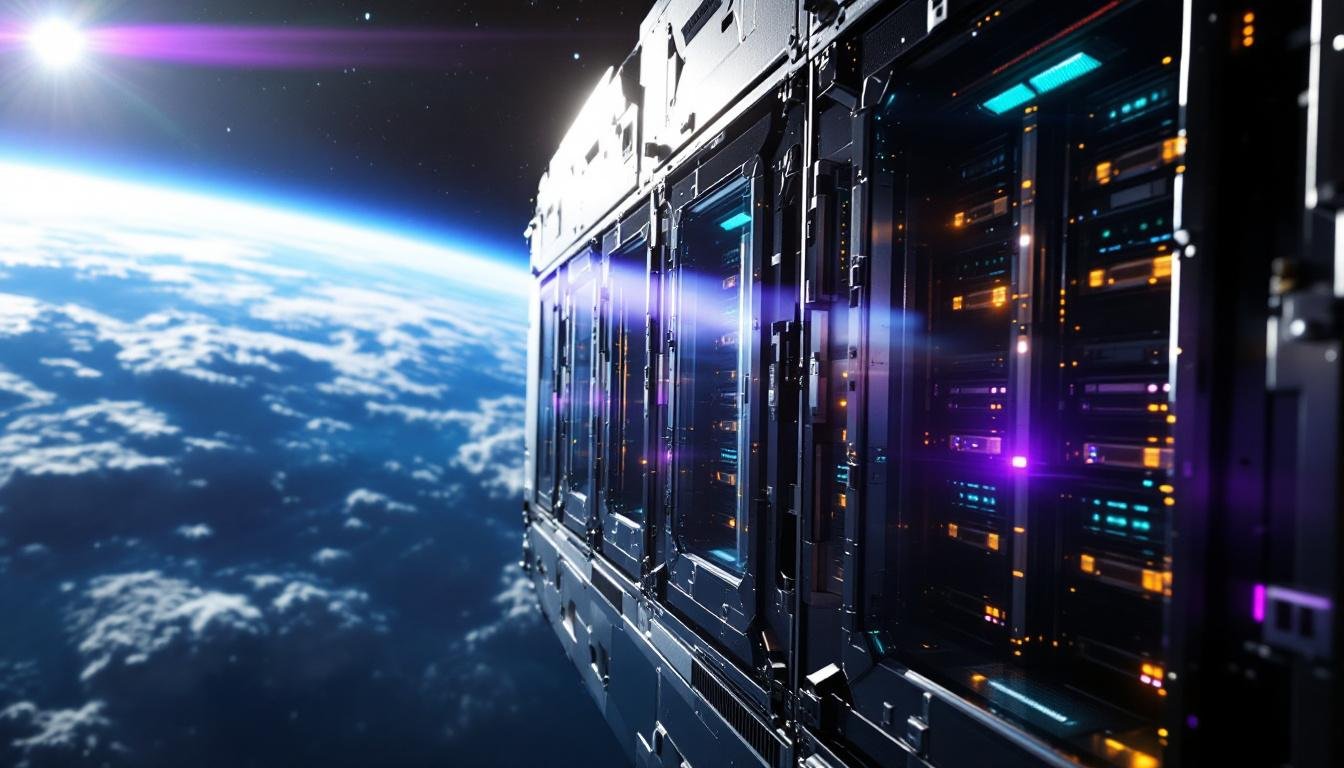
Think of orbital data centers like a distributed cloud network, except each node floats in space rather than sitting in a building. Individual satellites carry GPU-heavy clusters, linked via optical communications. Aggregate enough of them and you’ve built a hyperscale equivalent without a single power utility contract on Earth.
Starcloud launched its first AI-equipped satellite, Starcloud-1 (in mid-2025, through an NVIDIA Inception partnership). It’s testing GPU inference on high-data tasks including synthetic aperture radar (SAR) imagery, which generates around 10 GB per second and has historically required downlinking to ground stations before processing. And processing it on-orbit cuts that latency entirely.
Thermal Management in Space: Better Than It Sounds
Here’s the thing most people get wrong about thermal management in space: it’s not a problem, it’s an advantage.
On Earth, data centers fight heat constantly. They pump chilled water through hot aisles, spin fans, and run compressors. In orbit, the vacuum of space acts as an infinite heat sink. Servers radiate heat as infrared energy , with no fans, no water, no compressors. The ISS has used this passive radiative approach for decades. The ISS approach works reliably and has for decades.
Starcloud projects 10x CO2 savings over a facility’s operational lifetime compared to ground-based equivalents. And water usage drops to zero entirely. A 2,000-server orbital cluster radiates heat efficiently in microgravity by distributing thermal load across multiple satellites rather than concentrating it in a single structure. Large radiative panels, similar to those already flying on the ISS, handle 100% of thermal management passively.
A common challenge companies face when designing for orbital thermal management is balancing heat dissipation across dense GPU configurations. Unlike traditional rad-hard spacecraft components (which run cool and slow) commercial GPU clusters push enormous thermal loads per kilogram. Getting that heat to radiator panels efficiently, without conductive losses in microgravity, is one of the active engineering problems Starcloud-1’s 2025 mission is specifically designed to test.
3 Reasons Radiation-Hardened Electronics Define Viability
Space’s biggest hardware threat isn’t the vacuum or the temperature swings. The real threat is radiation. Cosmic rays and solar flares flip bits, corrupt memory, and degrade silicon over time. This is why traditional spacecraft use specialized radiation-hardened electronics : components built in low volumes at high cost, often years behind consumer performance curves.
Space data centers can’t afford that tradeoff at scale. Running thousands of servers across hundreds of satellites requires commercial-off-the-shelf (COTS) hardware that’s affordable and performant. And so the question shifts from “use rad-hard parts” to “make COTS parts survive.”
NASA’s TRL 6 Milestone Changes the Math
In February 2025, Lone Star’s Freedom mission deployed a lunar data center using Phase One’s 8TB M.2 SSDs, reaching NASA Technology Readiness Level 6 , meaning the hardware performed in a real space environment at relevant scale. That’s a meaningful milestone — TRL 6 is the threshold between lab demonstration and flight-ready system.
Based on Lone Star’s lunar deployment data, COTS SSDs with AI-driven error correction can sustain reliable read/write operations under radiation exposure conditions comparable to low Earth orbit. Pairing that with optical interlinks between satellites reduces single-point failure risks. Starcloud’s 2025 NVIDIA GPU demo builds on this foundation, targeting inference workloads that can tolerate managed error rates better than training runs can.
In practice, companies building radiation tolerance into COTS clusters rely heavily on redundancy at the software layer — running error-correcting code (ECC) memory, checkpointing compute jobs frequently, and distributing workloads so no single satellite’s degradation halts the cluster. It’s less elegant than purpose-built rad-hard chips, but it scales far better economically.
What SpaceX Starship Launch Costs Mean for the Business Case
Launch cost is the variable that makes or breaks the economics. At SpaceX Starship’s projected rate of $10 per kilogram to low Earth orbit, a 40-ton payload (servers, networking gear, cooling panels, power systems, excluding the spacecraft bus) costs approximately $400,000 to deliver. That sounds steep until you compare it to the land, power infrastructure, and construction costs of building a hyperscale data center on Earth in 2025.
As of mid-2026, Starship is targeting more than 100 flights per year. That cadence is the unlock. Space data centers don’t become viable with ten flights annually. They need continuous, affordable resupply and expansion capacity. Phantom Space’s Jim Cantrell frames this as a mass-manufacturing problem: build rockets the way you build cars, and launch costs continue falling.
Space Debris Collision Avoidance Adds Operational Complexity
But launch costs aren’t the only operational consideration. Space debris collision avoidance adds real complexity and cost to any orbital operation. There are currently more than 27,000 tracked debris objects in low Earth orbit. A constellation of data center satellites needs active maneuvering capability, which means onboard propulsion, which means mass and fuel, which means higher launch costs per satellite. In-space assembly robotics may eventually reduce this burden by allowing larger structures to be built from smaller, easier-to-maneuver components, but that capability is still early-stage.
Frankly, the debris environment in LEO is the part of this story that gets underplayed in enthusiastic coverage. It’s manageable now. Whether it stays manageable as satellite constellations grow to thousands of units is a genuine open question that operators need to plan for today.
When Space Data Centers Have Real Limitations
Space data centers aren’t the right answer for every workload, and the timeline to broad deployment is longer than some headlines suggest.
Latency is the most fundamental constraint. Even at LEO altitudes of 550 kilometers, round-trip signal times add measurable delay compared to a ground-based server in the same city. Applications requiring sub-5ms response times (financial trading systems, real-time gaming infrastructure, certain AI inference endpoints) aren’t good candidates for orbital hosting in the near term.
Maintenance is essentially impossible at current costs. If hardware fails on orbit, you can’t send a technician. Redundancy has to be designed in from the start, which increases mass and cost per compute unit.
Scalability is still bottlenecked by launch cadence. Even with Starship at 100 flights per year, building gigawatt-scale orbital infrastructure takes years. Hyperscalers needing capacity now are better served by terrestrial builds, despite the constraints. And for organizations handling regulated data with strict sovereignty requirements, putting servers in orbit introduces legal complexity that has no clean resolution yet. Ground-based data centers in compliant jurisdictions remain the practical choice for that segment.
If you’re evaluating whether space data centers belong in your organization’s infrastructure roadmap, the most useful step right now is tracking two specific milestones: Starcloud-1’s published performance benchmarks from its 2025 mission, and Starship’s actual flight cadence through early 2026. Those two data points will tell you more about the real timeline than any projection does. Watch the hardware results, not the press releases.
Frequently Asked Questions
How do space data centers handle cooling without water?
Orbital data centers use passive radiative cooling, which means servers shed heat as infrared radiation directly into space — no water, no fans, no compressors required. Large radiator panels on each satellite structure dissipate heat reliably using the same physics that have kept the International Space Station thermally stable for over two decades. This makes thermal management in space fundamentally more sustainable than any ground-based approach.
What does it actually cost to launch a data center into orbit?
At SpaceX Starship’s projected rate of $10 per kilogram, a 40-ton server cluster payload costs roughly $400,000 in launch fees alone, before spacecraft hardware, integration, and operations. That number drops significantly as launch cadence increases and competition grows. Phantom Space and other providers are actively building competing options to push costs lower over the next several years.
Are space data centers safe from radiation damage?
Radiation is the primary hardware threat in orbit, but it’s manageable. NASA’s Lone Star Freedom mission in February 2025 validated commercial COTS SSDs at TRL 6 under real space conditions. Companies are combining radiation-hardened electronics for critical systems with AI-driven error correction on COTS components to balance performance and durability across large server clusters.
Which companies are actually building space data centers right now?
Starcloud launched an AI-equipped satellite in mid-2025 in partnership with NVIDIA, targeting GPU inference workloads. Phantom Space is developing its “Phantom Cloud” orbital computing service backed by mass-manufactured launch vehicles. Lone Star deployed a lunar data center (February 2025) using commercial off-the-shelf SSDs. These aren’t concept studies — they’re operational demonstrations with real hardware in real environments.
Will space data centers replace ground-based facilities?
Starcloud CEO Philip Johnston has predicted that nearly all new data center capacity will be orbital by 2035, though Phantom Space’s Jim Cantrell takes a more measured view, calling full-scale deployment “years off.” The practical near-term picture is hybrid: orbital facilities handling specific workloads like SAR imagery processing and AI inference, while regulated and latency-sensitive applications remain on the ground. Both experts agree the direction is clear even if the timeline isn’t.